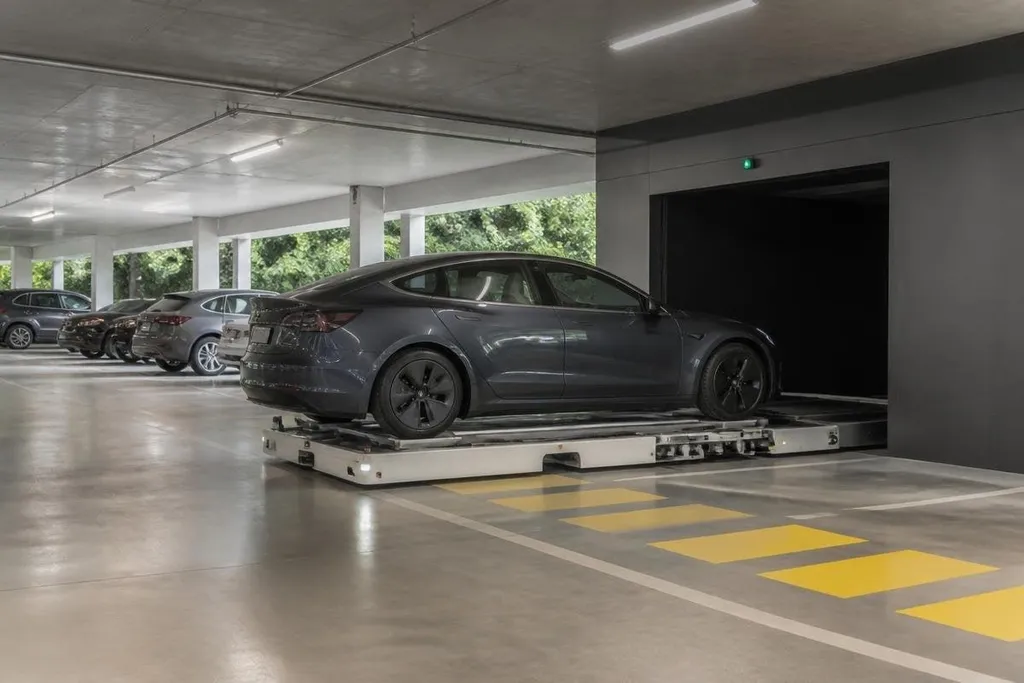
A parking robot moves a vehicle between a handover bay and a storage space without the driver searching for a free spot. The business case rests on three things: fitting more cars into the same building, reducing staff work, and charging for a service people find useful.
- More usable space: tighter parking layouts can leave more room for other property uses.
- New service revenue: operators can charge for automated parking, reservations, or priority access.
- A recurring support market: robots need software, sensors, repairs, and safety checks after installation.
The property opportunity
Because people don't need to open doors beside the car, a parking robot can place vehicles closer together. The system takes the vehicle at a marked handover bay, checks its position, and moves it to an assigned space.
That change matters most where land and floor space already cost a lot. An apartment building, hotel, hospital, or airport may gain room for more parking without adding another level. The extra income could come from parking fees, rent from other parts of the building, or a higher value for each property.
The trade-off is construction work. A robotic garage needs a handover area, sensors, control software, barriers, and a safe path for vehicles.
Retrofitting an old car park may cost more than building the system into a new site, especially where ramps, columns, or low ceilings limit movement.
Who can sell the system
The first opportunity sits with companies that build the robot and the control system. They can sell the equipment to a property owner, charge for installation, or offer the system under a lease. The right model depends on who wants to carry the repair and uptime risk.
A second market sits after installation. Operators need remote monitoring, software updates, replacement parts, cleaning, and planned service visits. A parking robot that stops working can block a vehicle, so the contract needs a clear response time and a manual recovery plan.
Those details matter more than a polished demonstration. A buyer should ask how the system handles a badly parked vehicle, a power cut, a blocked sensor, or a car that exceeds the stated size and weight limits.
Revenue beyond parking fees
Parking operators can sell a faster handover or reserved storage as part of a premium service. A hotel might include automated parking with a room package. An airport could connect the system to bookings, so a customer receives a space before arriving.
The software can also help operators see which spaces are occupied and when demand rises. That information may improve staffing and pricing decisions, but data rules still apply. Vehicle plates, booking details, payment records, and camera footage need careful handling.
Parking robots make sense when retrieval time, staffing, and service costs fit the site. Robot24 reports can put a machine’s test site, retrieval time, daily vehicle count, and price beside that claim, so you can judge the numbers before the business case breaks.
Where the business case breaks
A parking robot has a clear use when a site has high demand and limited room. The case weakens when drivers can park easily on nearby streets, land is cheap, or the building needs a large handover area that removes much of the space gain.
Wait time also matters. A system may fit more cars into storage, yet customers still judge the service by how long they wait at pickup. The operator needs enough robot capacity, charging access if the design requires it, and a process for peak arrival periods.
Price is another open issue. Without a named project, equipment quote, energy cost, and service contract, any payback claim would be guesswork. I’d start with the site’s daily parking demand and building cost, then test the robot against a conventional garage before discussing revenue.
A practical buying checklist
Use these checks before approving a parking robot project:
- Map vehicle flow: measure entry, handover, storage, pickup, and emergency access.
- Set vehicle limits: record the largest height, length, width, and weight the site will accept.
- Price the full system: include building work, software, installation, service, power, and staff training.
- Test failure handling: ask who retrieves a vehicle after a sensor fault or power loss.
- Measure peak demand: compare expected arrivals and pickups with the system’s stated movement rate.
- Protect customer data: define retention, access, and deletion rules for plates and camera records.
The best opening is a site where every extra parking space has a clear price. If the added revenue cannot cover construction, service, and recovery costs, the robot belongs in a proposal folder rather than a garage.